Why Your Commute Hits Different When the Singer Doesn't Speak Your Language
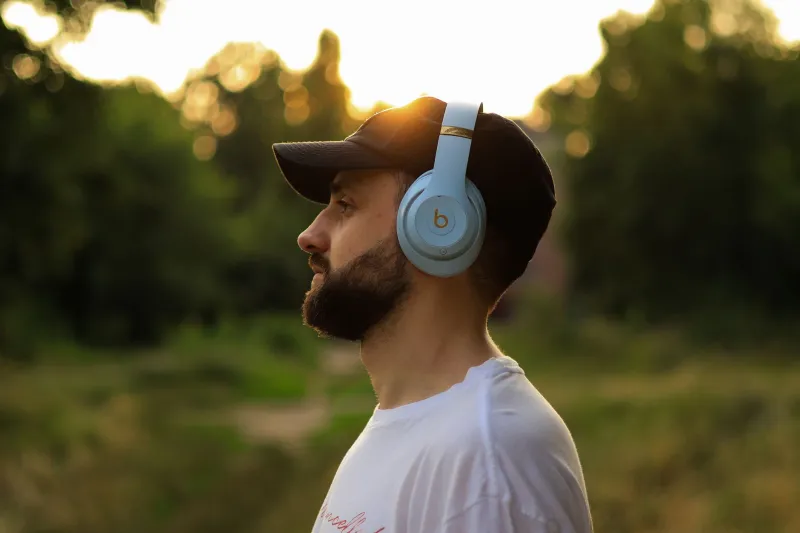
It happens somewhere around the third traffic light. The playlist shifts — maybe it's a Rosalía track, or something by Burna Boy, or a haunting piece by Japanese artist Fujii Kaze — and suddenly the gray stretch of highway in front of you looks different. The light catches the car ahead in a specific way. Someone walking a dog on the sidewalk moves with inexplicable grace. For approximately forty-five seconds, you are not stuck in traffic. You are in a scene.
This is the phenomenon that nobody has a clean name for yet, but everyone who's experienced it knows exactly what it is: the way non-English music, in particular, has a specific power to cinematize ordinary life. To make the mundane feel scored. To turn your Tuesday morning into something that belongs in a film festival submission.
And Americans, increasingly, are chasing that feeling on purpose.
The Playlist as a Lens
Streaming data tells an interesting story. Spotify has repeatedly reported that American users' listening habits have become dramatically more international over the past five years. Latin pop, Afrobeats, K-pop, French pop, Brazilian funk, Hindi film music — all of it is finding audiences far outside its geographic origin, and a significant chunk of that audience is American listeners who don't speak the language, have never visited the country, and may not be able to name a single other song by the artist.
They're not there for the lyrics. They're there for something else entirely.
"There's a concept in music psychology called semantic satiation," explains Dr. Lena Voss, a musicologist at a university in Philadelphia who studies cross-cultural listening habits. "When you hear words in your own language, your brain can't help but process them semantically — you're extracting meaning constantly. But when you hear a language you don't speak, that cognitive layer drops away. You're left with pure sound, pure melody, pure emotional texture. The music reaches you differently."
Differently, in this case, often means more. Without the intellectual processing of lyrics, listeners report feeling music more viscerally — more in the body, less in the analytical mind. The emotional impact can be more immediate, less mediated by whether the words are clever or clichéd.
TikTok and the Weaponization of Global Melancholy
If Spotify created the infrastructure for international discovery, TikTok created the emotional context. The platform has a very specific superpower: pairing music with visual moments in ways that create instant, viral emotional associations. And it turns out that foreign-language music is extraordinarily effective in this format.
A slow zoom on a rainy window with a Korean ballad underneath it hits differently than the same shot with an English-language equivalent. Part of this is novelty — unfamiliar sounds carry a certain freshness that overplayed domestic music can't replicate. But part of it is something more specific to TikTok's visual grammar.
"TikTok trained an entire generation to experience music as atmosphere rather than narrative," says Priya Menon, a digital culture writer based in New York who covers the intersection of social media and music. "And atmospheric music — music that creates a mood rather than tells a story — is incredibly well-served by languages you don't understand. The voice becomes another instrument. You're not following a story; you're inside a feeling."
This is why certain songs explode globally through TikTok despite having no English lyrics and no traditional Western promotional push. Colombian artist Manuel Turizo's "La Bachata." Stromae's French-language work. Indonesian pop, Nigerian Afropop, Thai indie. The algorithm doesn't care about language barriers. It cares about whether the music makes the video feel like something.
The Main Character Delusion (That Isn't Really a Delusion)
There's a phrase that gets thrown around somewhat mockingly online: "main character energy." The idea that someone is experiencing their life as if they're the protagonist of a film, with all the dramatic lighting and emotional scoring that implies.
But here's the thing — the international music soundtrack phenomenon is actually a fairly sophisticated psychological tool for accessing something real. Psychologists who study narrative identity — the way humans construct a sense of self through story — argue that experiencing your life with a degree of narrative distance can be genuinely healthy. It promotes reflection, emotional processing, and a kind of perspective that pure immersion in daily stress doesn't allow.
When a piece of music you don't fully understand turns your commute into something cinematic, you're not deluding yourself. You're briefly accessing your life as a story rather than a grind. That's not nothing.
"There's a long tradition of using art to create what philosophers call 'aesthetic distance,'" notes Dr. Voss. "A little bit of distance from your immediate experience — enough to see it as beautiful, or meaningful, or interesting — is psychologically valuable. Music does this very efficiently. International music does it with particular effectiveness because the unfamiliarity creates a natural frame around the experience."
The Sunset Ritual and the Curated Life
What's emerged, for many American listeners, is something that functions almost like a secular ritual. The sunset drive with the right playlist. The morning run timed to an Afrobeats mix. The solo dinner with French jazz that transforms eating leftovers into something that feels vaguely Parisian.
These are intentional acts of aesthetic curation — the use of global music to score personal moments with the emotional weight those moments deserve but rarely receive in the chaos of daily American life.
Instagram and Pinterest accelerated this, TikTok turbocharged it, but the impulse underneath it is older and simpler: the human desire to feel like your life is meaningful. Like the ordinary moments — the commute, the workout, the solitary cup of coffee — are worth experiencing fully rather than just enduring.
International music, with its built-in mystery and its ability to bypass the analytical mind, turns out to be remarkably good at delivering that feeling. You don't need to know what the singer is saying. Sometimes not knowing is exactly the point.
The words you can't understand leave room for the meaning you need to find.
Your Soundtrack Is Bigger Than Your Borders
There's something quietly beautiful about the fact that one of the most effective tools Americans have found for processing their own emotional lives is music made by people living completely different lives, in different languages, on different continents.
It's a reminder that the emotional frequencies — longing, joy, melancholy, exhilaration — don't require translation. They transmit directly. And when the right song hits at the right moment, it doesn't matter whether it was made in Lagos or Seoul or São Paulo or somewhere you couldn't find on a map.
The feeling is real. The cinematic moment is real. And your life, for a few minutes on a Tuesday morning with a song you don't fully understand playing at full volume — your life is genuinely, undeniably the movie.